
Specific Torque – The Measure of a Twin Screw Extruder
Diameter Rario (Do/Di): Also called the “Free Volume Ratio”, it decides how much Free Volume exists inside the barrel to accept and convey materials.
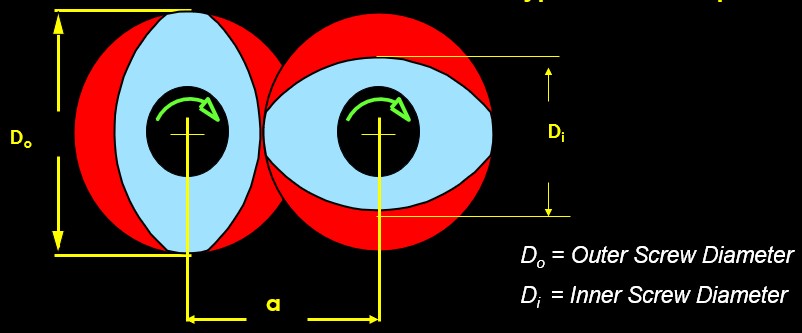
Figure 1 -- Typical 2-Lobe Profile
It is defined as the ratio of the Outer (major) Diameter to that of the Inner (minor) Diameter. The RED area visible in the cross-section of the extruder (Figure 1) is empty and can accept materials for conveying. Larger the Do/Di, bigger is this red area, greater is the empty space inside the barrel and higher is the conveying capacity. A high Do/Di ratio is good as it increases the conveying capacity and possible output of the extruder without changing barrel diameter.
But good things in life always come at a price!! In this case, the paradox lies in the fact that without changing barrel diameter, the Do/Di and the free volume shown in red can only be increased by decreasing the oval-shaped blue area of elements and round black area of shafts. This can be made possible only if the elements and shafts are made thinner. If this happens then the flight depth increases and the red area also increases hence more material can be conveyed to give higher output. However – and herein lies the catch -- higher output needs more power which now needs to be transmitted by thinner shafts of lesser diameter. This is one of the biggest challenges faced by manufacturers of such high performance TSEs today. Advancements in technology of metals have made it possible to address this problem to an extent which enables thinner shafts to carry larger amounts of power making it possible to increase output without increasing barrel diameter.
Centre Distance: In the quest for higher free volume, there is another issue. When shaft diameter is reduced, self-wiping profile, the centre distance “a” also needs to be reduced in order to maintain the all-important fully intermeshing. For a lower “a” value, the shafts come closer so there is less space available for bearings and gears in the gearbox and elsewhere in the power train. This, in spite of the fact that such extruders with a low value of “a” need to carry even more power but there is no space available to use larger gears and bearings. Again, this is a case of advancements in MoC. Such high performance screw shafts, bearings and gears make it possible to manage high power, torque and thrust with smaller sized components in the power train.
Specific Torque: Specific Torque is like an all-inclusive number that defines how “powerful” the extruder is. Mathematically, Specific Torque is defined as:
Sp. T = Md ÷ a3
where Md = Max. torque per shaft and a = center distance of the shafts.
Notice that “a”, the centre distance, is in the denominator and is raised to the cube. Hence it has a profound influence on the Specific Torque and a small reduction in the centre distance which results into a relatively large increase. Sp.T. will also increase when Md, the torque per shaft, is increased. In other words, a larger drive power at higher RPM (high RPM = high “Md” since “Md” increases with RPM) and stronger shafts placed close together (= low “a”) will result into higher Sp.T. Incidentally, this also translates into higher Do/Di and hence more free volume. So, a high Sp.T. means “a powerful extruder capable of giving high output”.
This is about as simple as it can get in terms of design concepts deemed important for choosing an efficient extruder. Generally speaking, high Do/Di and high Sp.T. may have the following advantages:
- Potential of higher output for the same diameter of the barrel
- Higher power efficiency
- Better intake capacity
- Lower total stress on the product
- Lower residence time
- Better venting
If you have any other questions or would like to suggest topics for us to write about, please feel free to contact us at info@polymerupdateacademy.com
Author
Dr. Pradeep Bakshi (Consultant – Plastics Technology)
Trainer at Polymerupdate Academy

